BankToons · Retirement
Roth IRA vs 401k: Which Is Better?
Roth IRA vs 401k: which is better? Two coworkers, Maya and Leo, start the same job in 2026 with the same pay, and each saves $500 a month. Maya opens a Roth IRA. Leo just checks the box for the 401(k) at work. Thirty five years later, Leo is about $200,000 ahead, but the lead changes hands along the way.
First, the map: the question is really two questions. A 401(k) or an IRA is about where the account lives (at work, or on your own). Roth or traditional is about when you pay the tax (now, or on the way out). Most plans at work also come in a Roth version.
Round 1, the 401(k) match explained: a common match is 50 cents for every dollar on the first 6% of pay. On $60,000 a year, that is $1,800 a year from the company. Some plans make you wait up to three years before the match is fully yours (vesting).
Round 2, fees: if Leo's fund charges 1% a year, Maya ends up about $3,000 ahead after 35 years. Once Leo switches to the plan's low cost index fund, Leo is about $200,000 ahead (about $1.1 million against $850,000, at 7% a year before fees, an assumption, not a promise).
Round 3, access: what you put into a Roth IRA can come back out at any time with no tax and no penalty; most 401(k) plans only allow a loan or a hardship withdrawal. Round 4, Roth vs traditional: at the same tax rate it is an exact tie; what decides it is your tax rate now against later.
The order many planners suggest: 1) the 401(k) up to the full match, in its cheapest index fund; 2) a Roth IRA (up to $7,500 a year in 2026); 3) back to the 401(k) (up to $24,500 a year in 2026). Our take: check your next pay stub and your plan's app, get the whole match, check what your fund charges, lean Roth early in your career, and split it if you are not sure. This video is for education, not personal financial advice.
Roth IRA vs 401k: which is better?
Which is better for retirement, a Roth IRA or a four-oh-one-k? Two coworkers are about to find out. In 2026, Maya and Leo start at the same company, on the same day, for the same pay.
Each one saves $500 a month. Maya has read that a Roth IRA, a retirement account outside of work, is the best choice there is. So Maya opens one.
Leo does not read anything. Leo just checks the box for the four-oh-one-k, the retirement plan at work. 35 years later, Leo is about $200,000 ahead.
But it is not a straight line. The lead changes hands along the way. So what happened?
And which one of them are you?
Roth IRA vs traditional IRA vs 401k, explained
First, a quick map. If you have ever stared at the sign-up page at work, you have seen both words. That question is really two questions in one.
It is a bit like asking which is better, a pickup truck or the color blue. One is the vehicle. One is the paint.
The four-oh-one-k is named after a section of the tax code. IRA stands for individual retirement account. Anyone with a paycheck can open one on their own, at a brokerage.
A brokerage is a company that holds your investments, like a bank for stocks. So the first question is where your account lives. At work, or on your own.
The second question is when you pay the tax. That is what Roth is about. With a Roth, you pay the tax now.
Then the money grows, and you owe nothing when it comes out in retirement. The other kind is called traditional. No tax going in, and tax on the way out.
Most plans at work also come in a Roth version. Leo picks it. So both of them get taxed the same way, and the race is fair.
Round 1: the 401k match explained
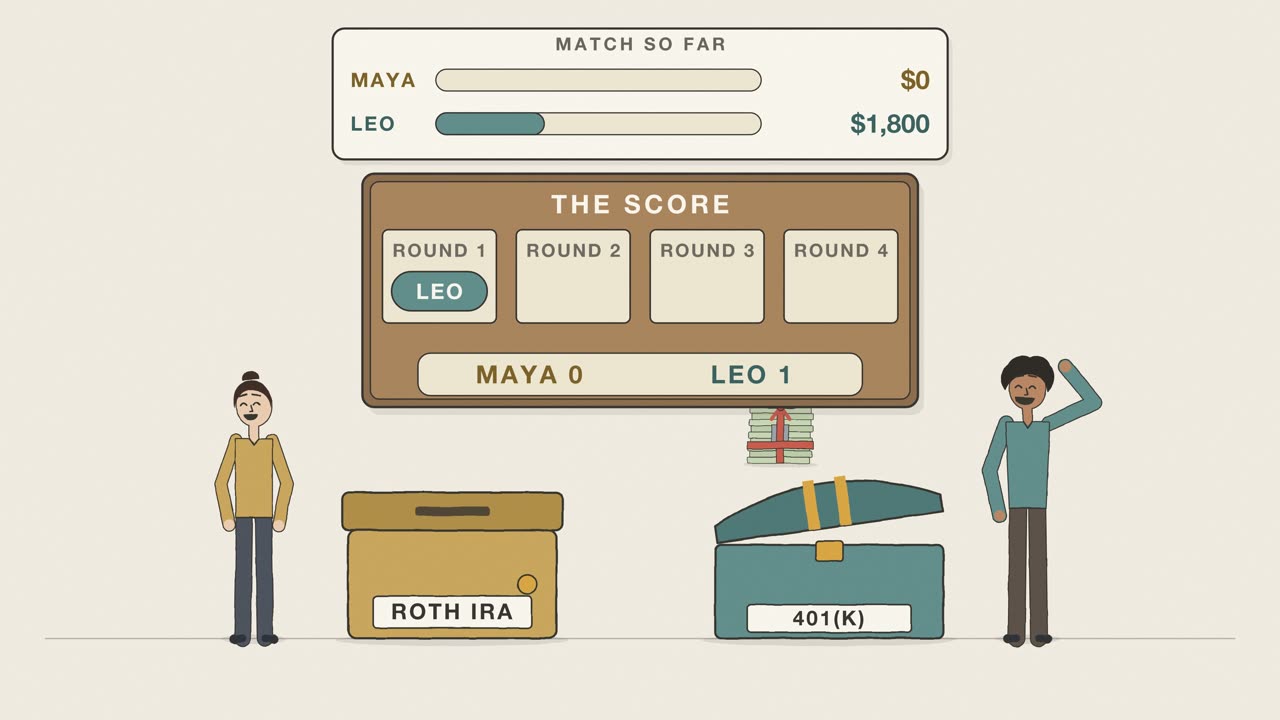
Round one. Payday. Leo earns $60,000 a year, a bit under what a typical full-time worker makes.
Leo's first pay stub has a line Maya's never will. It is called a match. For every dollar Leo puts in, the company adds 50 cents, up to 6% of pay.
That is a common match. Now picture your own paycheck. Leo puts in $3,600 a year.
The company adds 1,800. Keep that number in mind. That money is free.
Maya skipped the plan at work, so Maya gets none of it. Maya does not even know it is there. Round one goes to Leo.
The match is free money.
Vesting: when the match is really yours
Then, in year two, a twist. Another company offers Leo a job. Leo almost says yes.
Then Leo reads the fine print. By now the company has added $3,600. But Leo's plan makes you stay three years to keep it.
Leave early, and the company takes it back. That waiting period is called vesting. About half of plans let you keep the match right away.
Leo stays one more year. Now the match is $5,400, and every dollar is Leo's. If a job offer ever lands in your inbox, check your vesting date first.
Round 2: 401k fees and index funds
Round two. The menu. Leo never chose a fund.
The plan picked one for him, and it charges 1% a year. Some plans, especially at small companies, still have funds like that. Maya picked a plain index fund that charges almost nothing.
An index fund is a fund that owns a slice of every company on a list. 1% sounds tiny. But it comes out every year, from all of Leo's money, for 35 years.
Say both accounts grow 7% a year before fees. Nobody can promise that. By retirement, the fee has eaten almost all of the match.
Maya is now ahead, by about $3,000. Round two goes to Maya. A high fee can wipe out free money.
The fix takes a minute. Many plans also offer a cheap index fund on the same menu. Leo switches.
Now Leo ends up about $200,000 ahead, even after tax. That is the gap from the start of our story. If your job offers a match and you skip it, you are Maya.
If you never check your fund, you are Leo before the switch.
Round 3: taking money out early
Round three. The car breaks down. Say Maya's car needs a $3,000 repair.
Maya takes $3,000 out of her Roth IRA. No tax, no penalty. That works for the money Maya put in.
The growth has to wait, usually until age 59.5. Now say it is Leo's car.
Leo's plan is stricter. Most plans only let you take money out early through a loan or a hardship withdrawal. So Leo borrows the $3,000, and pays it back out of every paycheck, with interest.
A hardship withdrawal is worse. It can mean tax, plus a 10% penalty on the growth. Round three goes to Maya.
The Roth IRA is easier to reach. That makes it two rounds to one. Leo has more money.
Maya has more freedom.
Round 4: Roth vs traditional 401k
Round four. The raise. A few years in, Leo gets a raise, to $75,000.
Good news, with a catch. A raise can push your top dollars into a higher tax rate. For Leo, that is from 12% to 22%.
So now the other question matters. Roth or traditional. Pay the tax now, or pay it later.
Take a guess. Here is the surprise. If your tax rate is the same now and later, both end with the same money.
Picture $1,000. Roth takes the tax at the start. Traditional takes it at the end.
Let it grow, and both land on $7,800. It is a tie. So the only thing that matters is your tax rate.
If it is lower now than it will be later, pay it now, with a Roth. If it is higher now, wait, with traditional. Before the raise, Leo paid 12%, so the Roth made sense.
After the raise, Leo pays 22%. If Leo expects to pay less in retirement, traditional starts to win. Nobody knows tax rates 35 years from now.
That is why many people split their money between the two. Round four is a draw.
Pros and cons of each account

So who won? Here is the score, in plain words. The four-oh-one-k.
The good part is the free match money, and a bigger limit. The bad part is a short menu, and money that is hard to reach. The Roth IRA.
The good part is any fund you like, and deposits you can take out any time. The bad part is a smaller limit, and no match. So neither one wins every round.
But you can. Here is a strategy many people recommend. It has three steps.
Max out the Roth IRA or 401k first? The 3 steps
Step one. Put enough into the four-oh-one-k to get the full match, and pick its cheapest index fund. That wins rounds one and two.
If your job has no match, start at step two. Step two. Open a Roth IRA, and put in what you can.
In 2026, the limit is $7,500 a year. Big brokerages like Fidelity, Charles Schwab, Vanguard and Robinhood all offer one, with nothing to pay to open it. That wins round three.
Step three. If there is still money left, go back to the four-oh-one-k. It takes up to $24,500 a year.
And splitting Roth and traditional covers round four. Here is how that looks with the same $500 a month. 300 goes to the plan at work.
That is enough to get the whole match. The other 200 goes into a Roth IRA. Same money.
The full match. The low fee. And money you can reach.
Roth IRA vs 401k: the answer
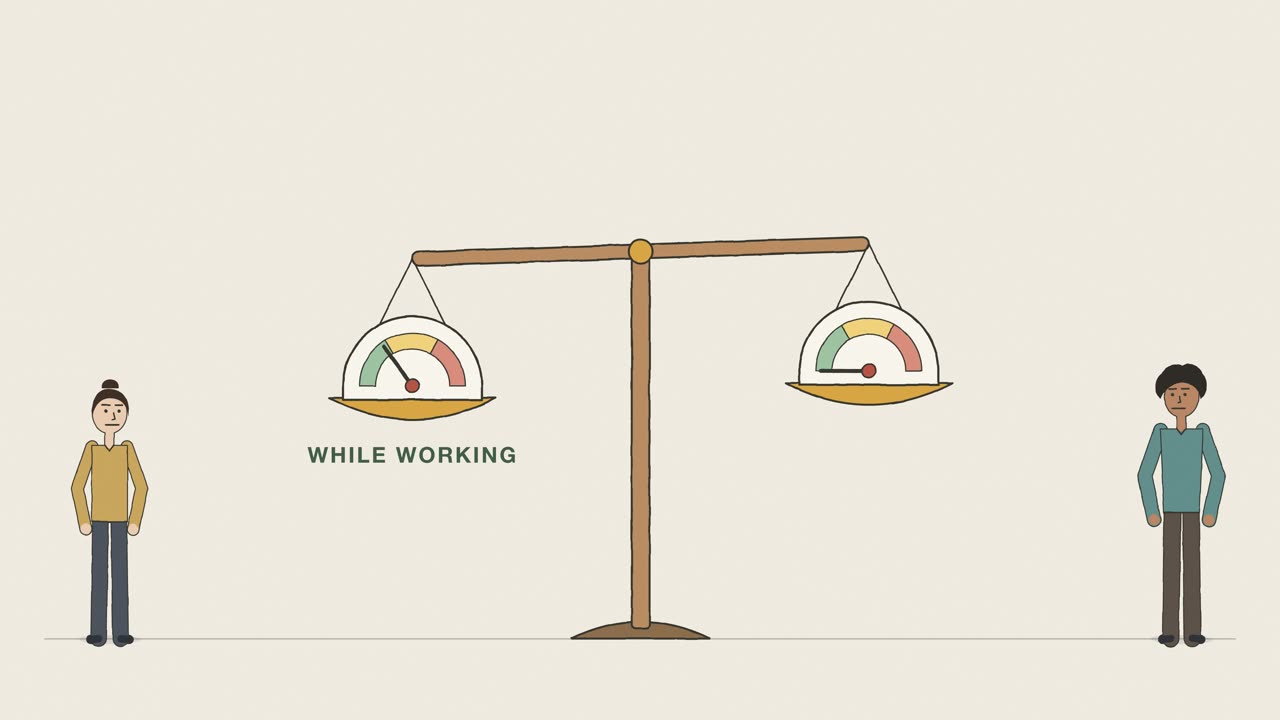
So, which is better, a Roth IRA or a four-oh-one-k? Usually, both, in the right order. The match comes first, because nothing else adds 50 cents to each dollar on the day it goes in.
Then the Roth IRA, for its choices and its access. Then the four-oh-one-k again, for its bigger limit. And Roth or traditional comes down to one thing.
Your tax rate now, against your tax rate later.
Our take
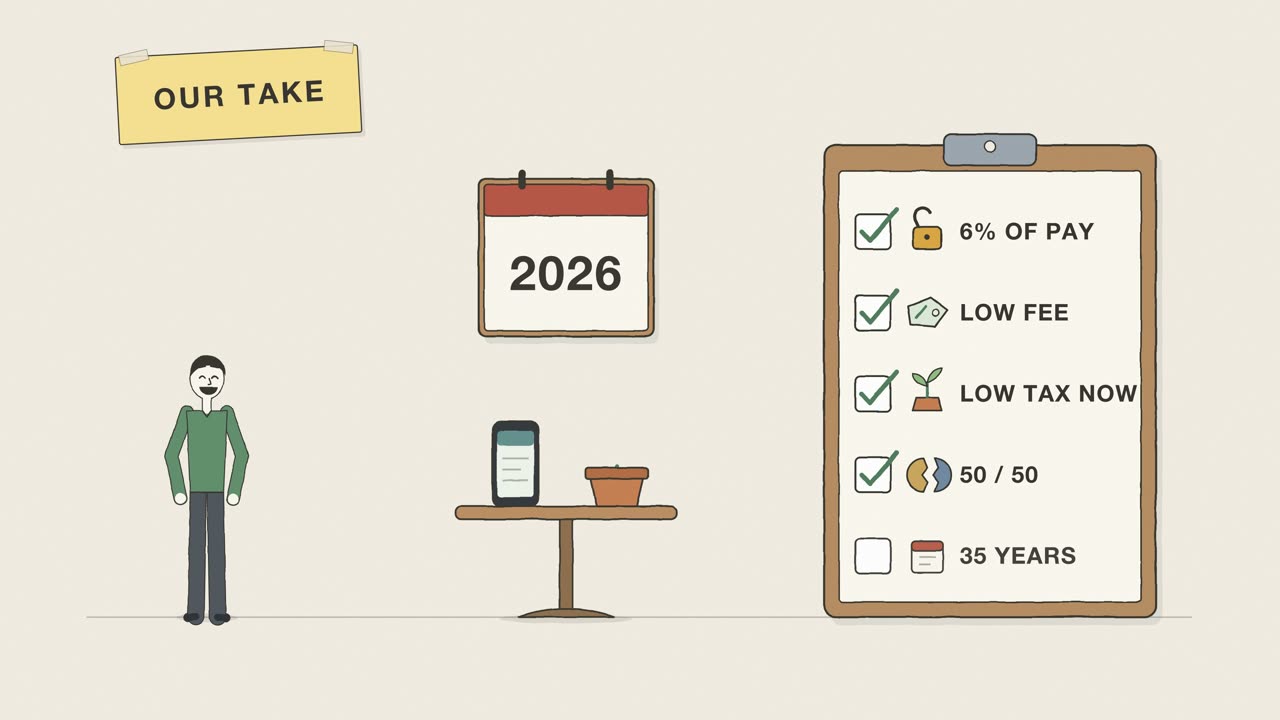
Here is our take. Open your next pay stub and your plan's app. Make sure your savings unlock the whole match.
Check what your fund charges, and look for the plan's index fund. If you are early in your career, lean Roth. If you are not sure, split it.
Then leave it alone, and let the years do the work. Maya picked a good account. Leo picked the free money.
Free money goes first.